TREE OF LIFE
MORE INFO
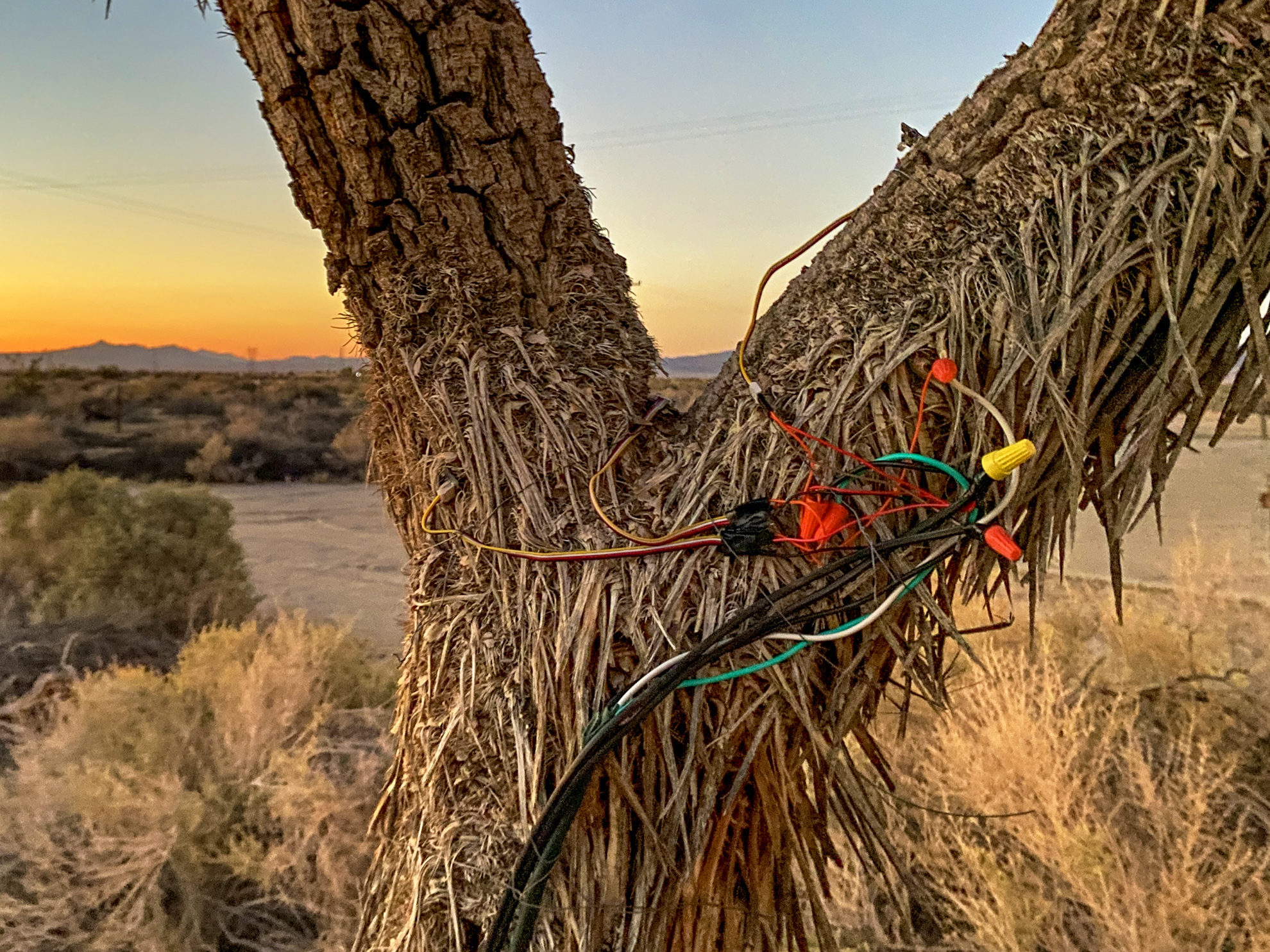
(2020-ongoing) The Tree of Life is the primary project of the Space Song Foundation. The project is a 200-year global public art piece that harnesses trees as antennae in communication with satellites in Low Earth Orbit. The trees are outfitted with sensors that collect data about light, moisture, and temperature, which is saved every minute. The data is sonified by artists and scientists for various uses.
EXHIBITION: Upgrade Available, ArtCenter College of Art and Design, Spring 2020
EXHIBITION: Remote Sensing: Explorations into the Art of Detection, Center for Land Use Interpretation, Spring 2025
LINK: The Tree of Life: Kickstarter Project
VIDEO: “Julia Christensen and the Tree of Life,” LACMA, May 2, 2019
VIDEO: “Listening to the Trees,” LACMA, August 27, 2019
ARTICLE: “Julia Christensen partnered with scientists and engineers at NASA’s Jet Propulsion Laboratory,” by Brian Boucher, Artnet, December 8, 2020
ARTICLE: “Oberlin artist plans space art project for mission to planet 4.2 light years from Earth,” by Steven Litt, Cleveland Plain Dealer, December 6, 2020
ARTICLE: “Tree Thinking,” by Shannon Mattern, Places Journal, September 2021
SPACE SONG FOUNDATION

MORE INFO
(Current) The Space Song Foundation is a non-profit based in Los Angeles, CA, founded by artist Julia Christensen and aerospace engineers and scientists. The organization’s mission is to center longevity-thinking at the intersection of science, art, and engineering, on Earth and in outer space.
VIDEO: “Artist Julia Christensen works with NASA scientists on spaceship & art concepts,” produced by the Los Angeles County Museum of Art / Art + Tech Lab
LINK: Space Song Foundation website
INTERVIEW: Conversation between Julia Christensen and Dr. Anthony Freeman of JPL at LACMA, Oct. 28, 2018
STARLINK LINK
MORE INFO
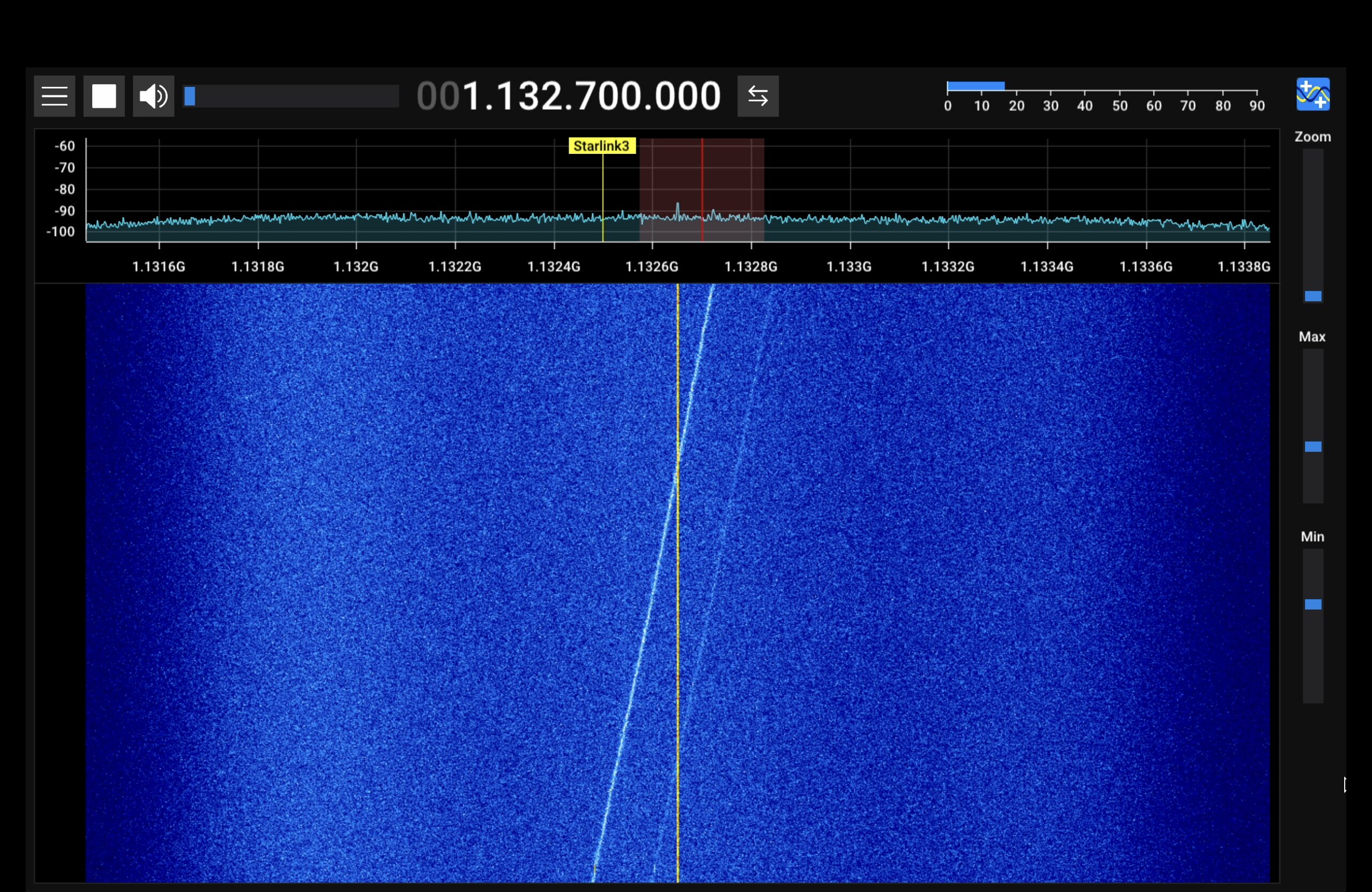
(2024-2025) Video installation comprised of five videos on small scientific monitors. Each video displays a software defined radio visualization of Starlink satellites in Low Earth Orbit. Each video demonstrates different characteristics of the Starlink network.
VIDEO: “Artist tracks Elon Musk’s Starlink Satellites” | Fusing Art & Science | PBS SoCal
EXHIBITION: “Remote Sensing in the Desert: CLUI Exhibit at the Desert Research Station,” Center for Land Use Interpretation, Lay of the Land Newsletter, Spring 2025
TREE SONGS / ART CENTER
MORE INFO
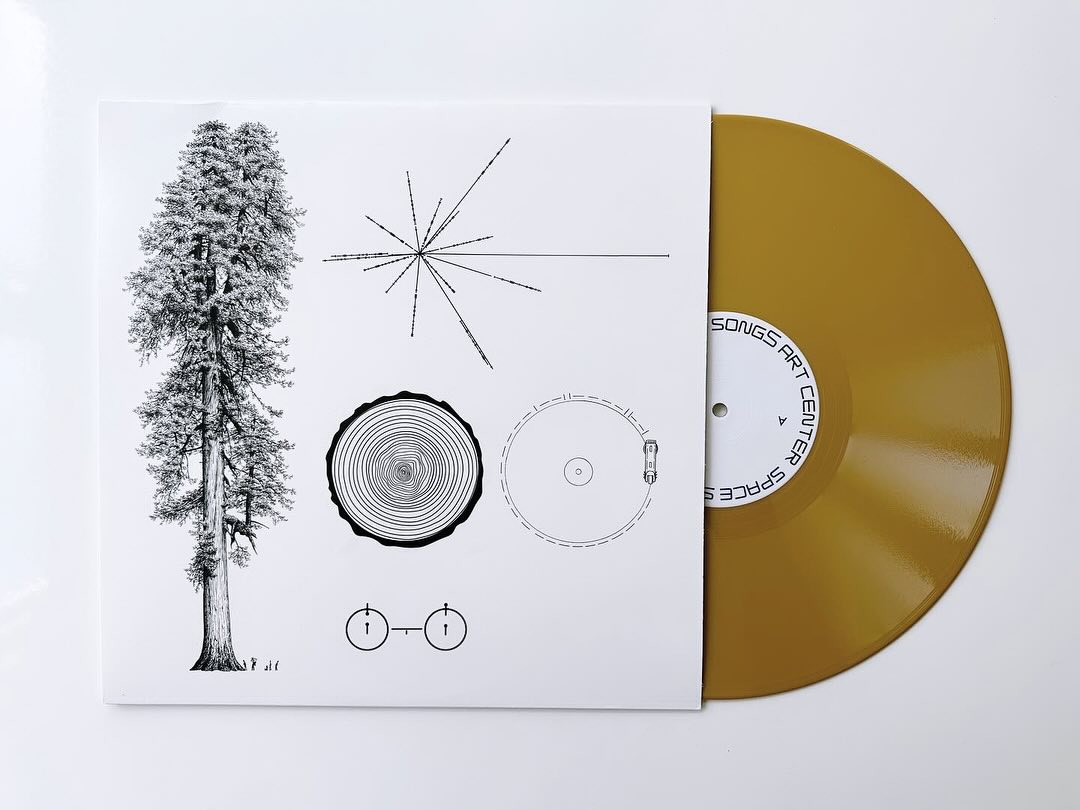
(2024) Vinyl record with tracks composed by Tom Hall and Julia Christensen. Songs composed using data collected from three live trees in the gallery at Upgrade Available: Julia Christensen, the 2020 solo exhibition at ArtCenter.
LINK: Tree Songs / Art Center on Bandcamp
ARTICLE: “A Cosmic Duet,” by Eloise Rich, Oberlin Research Review
VIDEO: “Beyond the Physical: A Conversation Between Tom Hall & Julia Christensen, Moderated by Laetitia Sonami,” July 8, 2020
UPGRADE AVAILABLE
MORE INFO
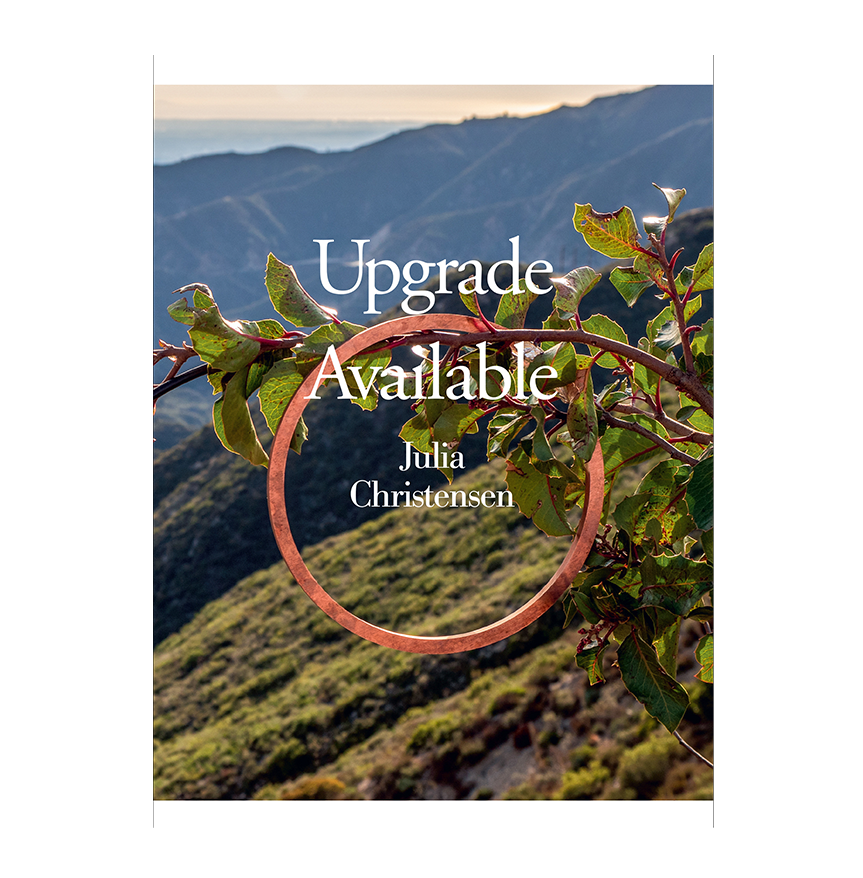
(2020) This volume documents an ongoing investigation by artist Julia Christensen into how our relentless “upgrade culture”—the perceived notion that we need to constantly upgrade our electronics to remain relevant—fundamentally impacts our experience of time. In a personal narrative interspersed with related interdisciplinary artwork and conversations with experts from different fields (other artists, archivists, and academics), Christensen takes readers along a path from the international e-waste industry to institutional archives, eventually leading her to NASA’s Jet Propulsion Laboratory (JPL). At JPL, Christensen began a dialogue with a group of exo-planetary scientists, engineers, and machine learning experts to develop long-lived space mission concepts that include an update of the Voyager spacecrafts’ 1977 “Golden Record,” to be embedded on a hypothetical future interstellar spacecraft. In taking on this challenge, Christensen—a female pioneer redefining the intersection of art, technology, and outer space—must envision an artwork for an evolving, autonomously upgrading spaceship headed toward a potentially habitable planet in another star system. Her years-long investigation into upgrade culture leads to design concepts that potentially transcend technological obsolescence altogether.
BOOK: Upgrade Available, Dancing Foxes Press
EXHIBITION: Upgrade Available: ArtCenter, Pasadena, CA, 2020
ARTICLE: “Julia Christensen’s Upgrade Available,” by Hall Rockefeller, Brooklyn Rail, October 2020
ARTICLE: “An Artist Investigates the Effects of Technological Obsolescence,” by Elisa Wouk Almino, Hyperallergic, April 21, 2020
ARTICLE: “Longevity Feels a Bit Elusive at the Moment: Artist Julia Christensen explores upgrade culture in new book and postponed show,” by Wallace Ludel, Art Newspaper, April 13, 2020
ARTICLE: “‘We are enacting a planetary crisis with electronics’- An Interview with Julia Christensen, by Gabrielle Schwarz, Apollo Magazine, Ocober 15, 2020
ARTICLE: “Outmoded Tech is Making Piles of Waste. Is there Any Stopping ‘Upgrade Culture?” by Liz Ohanesian, LA Magazine, September 18, 2020
HARD COPY
MORE INFO
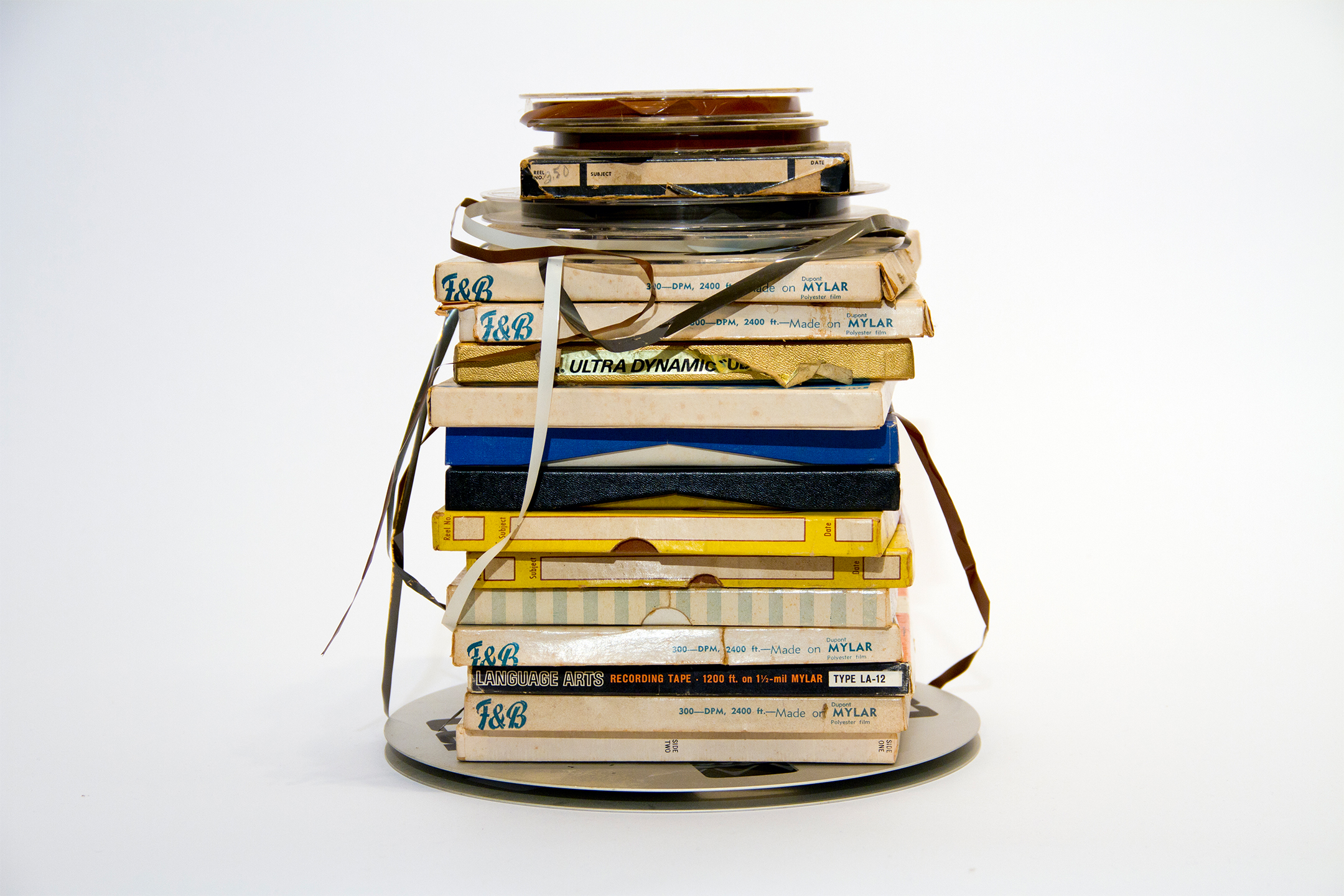
Hard Copy is a series of photographs of media collections stored in the basements and attics of friends and neighbors. Each media collection is obsolete, and will probably never be accessed again by the owners, and yet the collections persist.
VIDEO: “Julia Christensen on Upgrade Available,” LACMA, September 3, 2018
ARTICLE: “Not if, but when: an artist looks into upgrade culture,” by Lydia Pyne, July 19, 2020
TECHNOLOGY TIME
MORE INFO
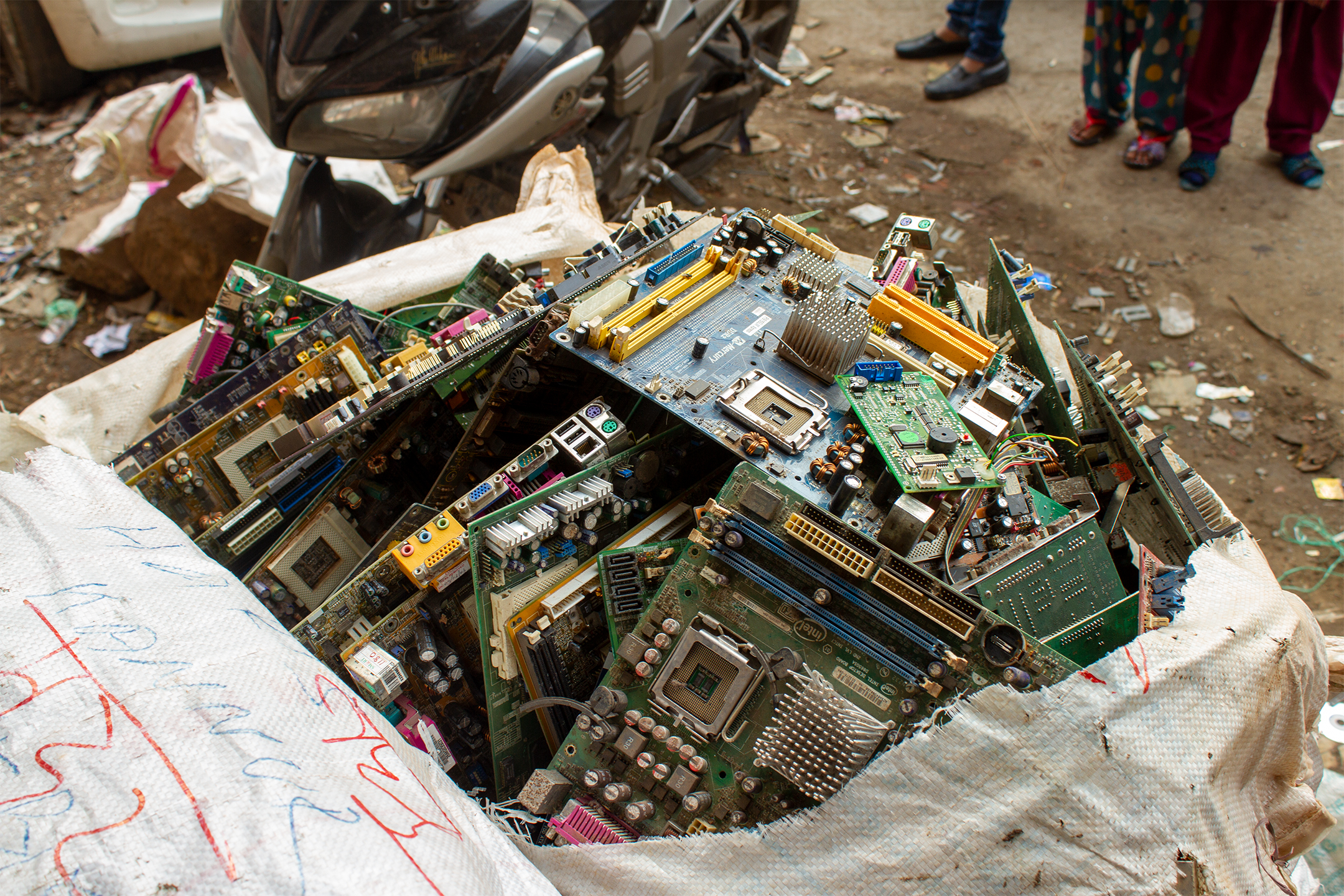
Technology Time is a series of photographs taken in electronic waste processing centers across India. The term “technology time” refers to the short frames of time determined by planned obsolescence and forced upgrades. These short, false time frames restrict the public imagination, and ultimately generate an unfathomable aggregate of trash.
EXHIBITION: “A Time for Farewells” at Haverford College, Haverford, PA
EXHIBITION: “A Time for Farewells” at Shrine Empire Gallery, New Delhi, India
ARTICLE: “The exhibition ‘A Time for Farewells’ takes viewers on a journey into the future,” by Pallavi Chattopadhyay, The Indian Express, August 1, 2019
WE SHARE OUR PICTURES
MORE INFO
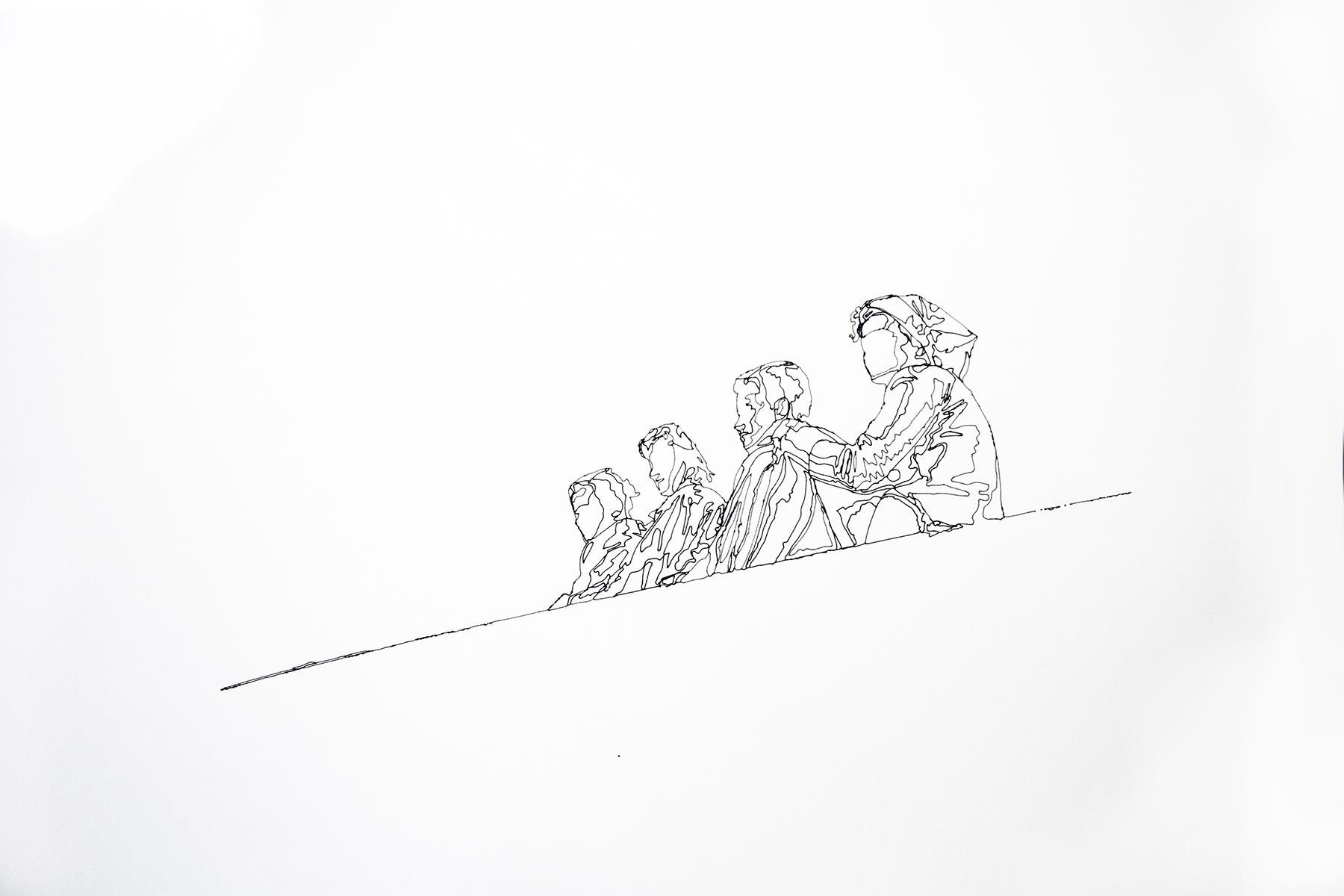
We Share our Pictures is a series of triptychs of drawings made on a plotter. Each drawing is derived from a 35mm slide. Christensen collected slide collections of deceased people on eBay, and pulled out archetypal triptychs across collections. For each grouping, she chose two slides from the anonymous collections, and one slide from her parents’ slide collections. Although her parents’ collections are personally relevant to her, they will also be part of the plane of anonymous vernacular photography one day.
EXHIBITION: Upgrade Available at Art Center College of Art & Design
BURNOUTS
MORE INFO
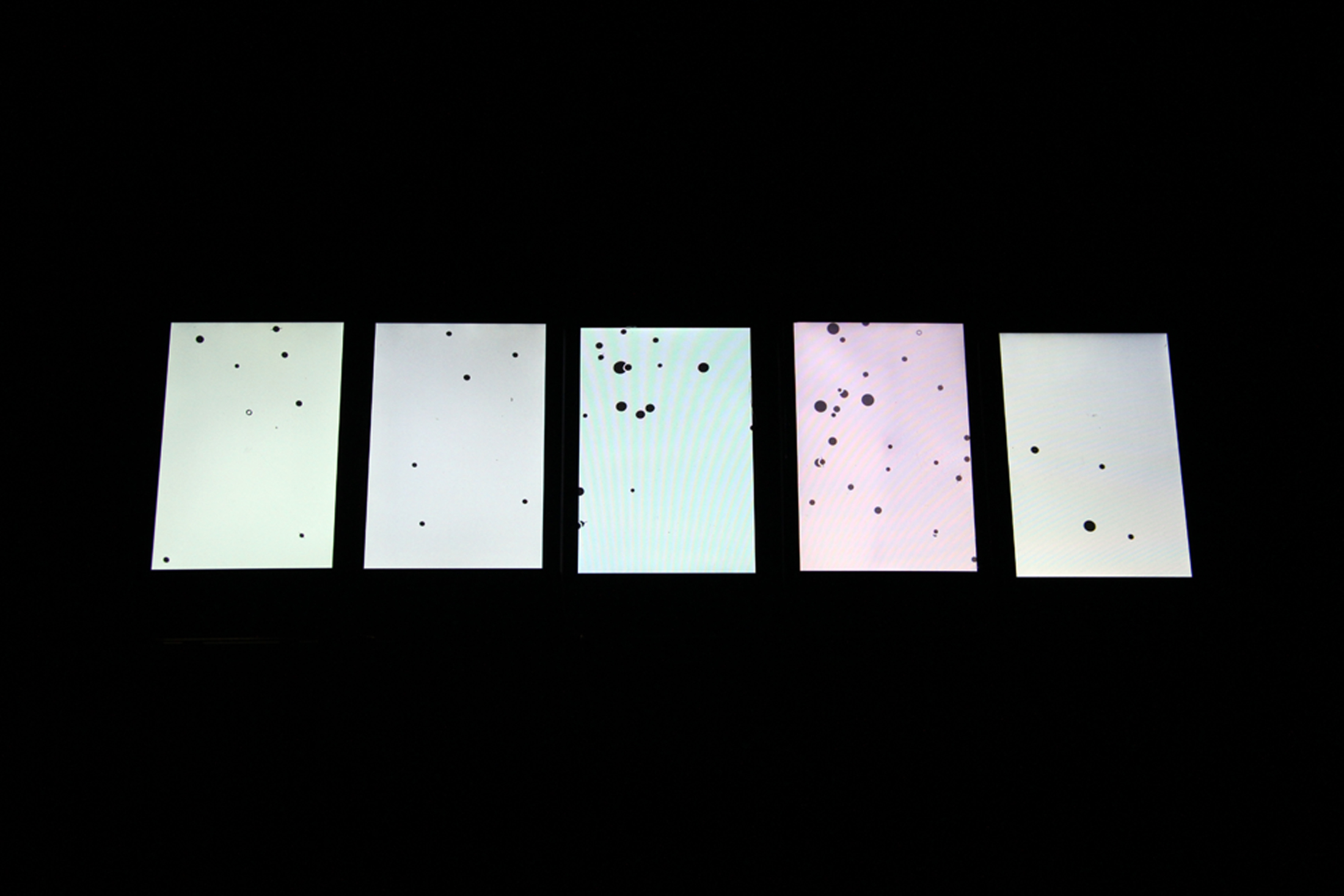
Burnouts is a series of self-designed video projectors that use obsolete iPhones as the sole light source. The iPhones display animations of retired constellations in the night sky; these constellations have been deemed no longer relevant to the study of celestial bodies, mostly due to light pollution. The constellations are still there, but have been deemed culturally obsolete, just like the iPhones that display them.
Burnouts 2.0 is a version of the installation in which the iPhones are displayed on the wall of the gallery, without the projector units.
VIDEO: “Media Artists Turns Old iPhones into Art,” produced by Creative Capital, September 2014
EXHIBITION: “Burnouts” at the Center for Ongoing Research & Projects, Columbus, OH, 2014
EXHBITION: “Burnouts” at 21C Museum Hotel, Louisville, KY, 2013
ARTICLE: “Interview: Julia Christensen,” by Kris Paulsen, Bomb Magazine, March, 2014
ARTICLE: “We Talked to the Artist Turning E-Waste into Projected Star Maps,” by Willa Koerner, VICE Magazine, Oct. 16, 2014
ARTICLE: “Tiny space illuminates big pictures of cosmos,” by Melissa Starker, Columbus Post-Dispatch, March 30, 2014
ARTICLE: “Burnouts: tracking obsolete asterisms,” by Julia Christensen, Cabinet Magazine, Spring 2014
WAITING FOR A BREAK
MORE INFO
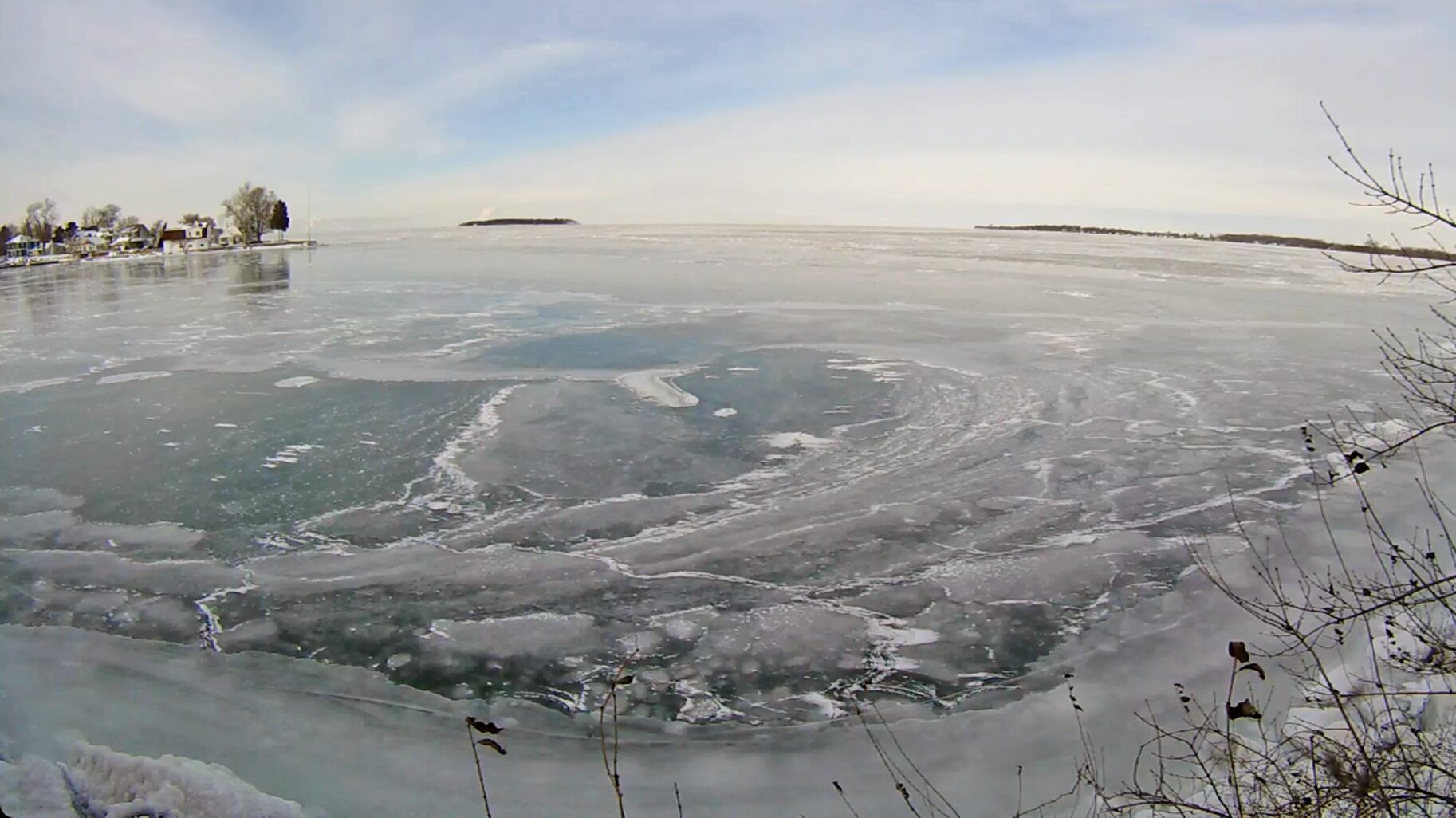
Waiting for a Break was a live, months-long documentation of the ice on Lake Erie as it formed, froze, and eventually cracked in th winter of 2018. Live cameras were installed on islands across Lake Erie, streaming live footage of the surface of the lake 24/7. Christensen installed a large video monitor on Public Square in Cleveland to display the video feeds around the clock. SPACES gallery simultaneously produced a solo show of the project, which included time-lapse videos of the ice action, photographs, and documentation from the project.
VIDEO: “Waiting for a Break: A Project by Julia Christensen” produced by Oberlin College
EXHIBITION: Waiting for a Break at SPACES, Cleveland, OH, 2018
ARTICLE: “The Fine Art of Thin Ice,” by Jillian Steinhauer, Pacific Standard Magazine, December 2018
ARTICLE: “New Art Exhibit, “Waiting for a Break,” on Lake Erie,” by Elizabeth Miller, Great Lakes Today, NPR
ARTICLE: “Public art on Public Square will show the ice forming, breaking,” by Laura Johnston, Cleveland Plain Dealer, November 15, 2017
ARTICLE: “Artist Julia Christensen reveals Lake Erie’s winter magnificence in show at SPACES,” by Steve Litt, Cleveland Plain Dealer, February 3, 2018
ARTICLE: “Julia Christensen has us all waiting for a break,” by Brittany Hudak, CAN Journal, December 2017
ARTICLE: “Art from the North Coast to the West Coast,” by Hillary Hempstead, Oberlin Alumni Magazine, Winter 2017
PHONEY
MORE INFO
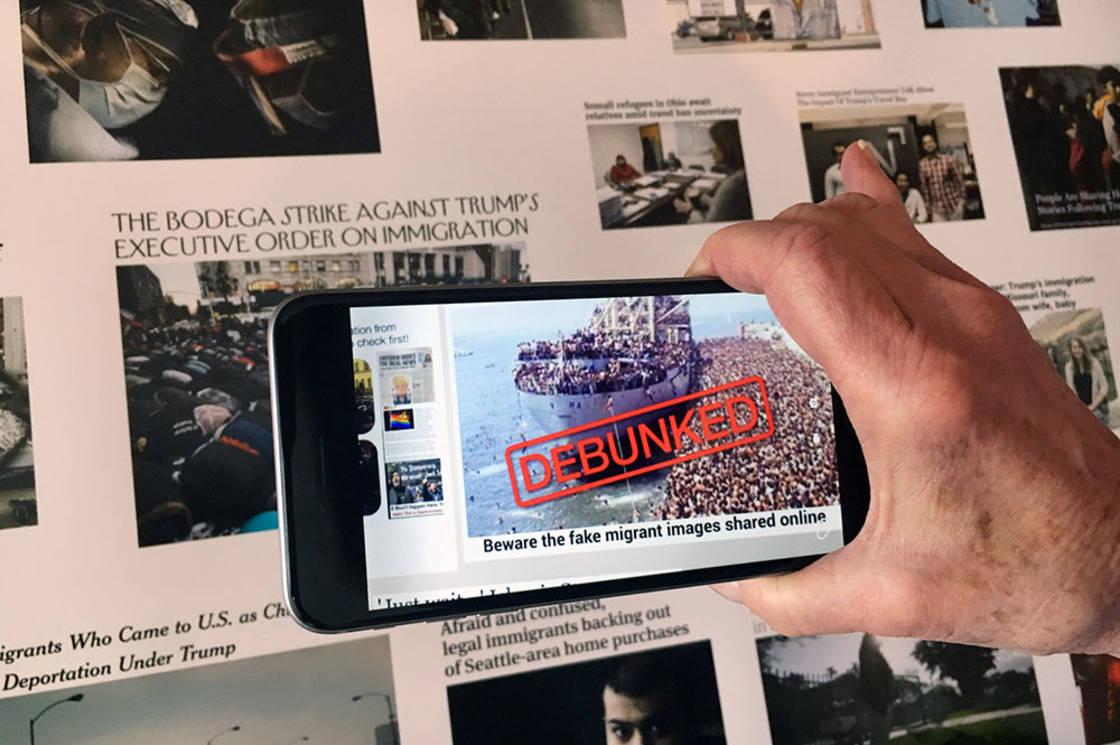
Phoney was commissioned by SPACES as part of the exhibition, The First 100 Days. The project uses augmented reality to obscure headlines, creating a commentary on how the public views the news through their phones and social media.
EXHIBITION: “The First 100+ Days,” SPACES, Cleveland, May-June 2017
ARTICLE: “Cleveland area artists respond to the ‘First 100+ Days” of Trump in SPACES exhibit,” by John Benson, Cool Cleveland, May 5, 2017
ARTICLE: “Damage Assessment: The First 100+ Days, at SPACES,” by Douglas Utter, CAN Journal, May 2017
ARTICLE: “Ohio Artists Respond to Trump’s First 100 Days,” by Carrie Wise, NPR/Ideastream, April 27, 2017
ARTICLE: “SPACES takes on Trump’s First 100 Days in witty artistic critiques of immigration policy,” by Steven Litt, Cleveland Plain Dealer, May 5, 2017
THE CHUCK CLOSE TAPES
MORE INFO
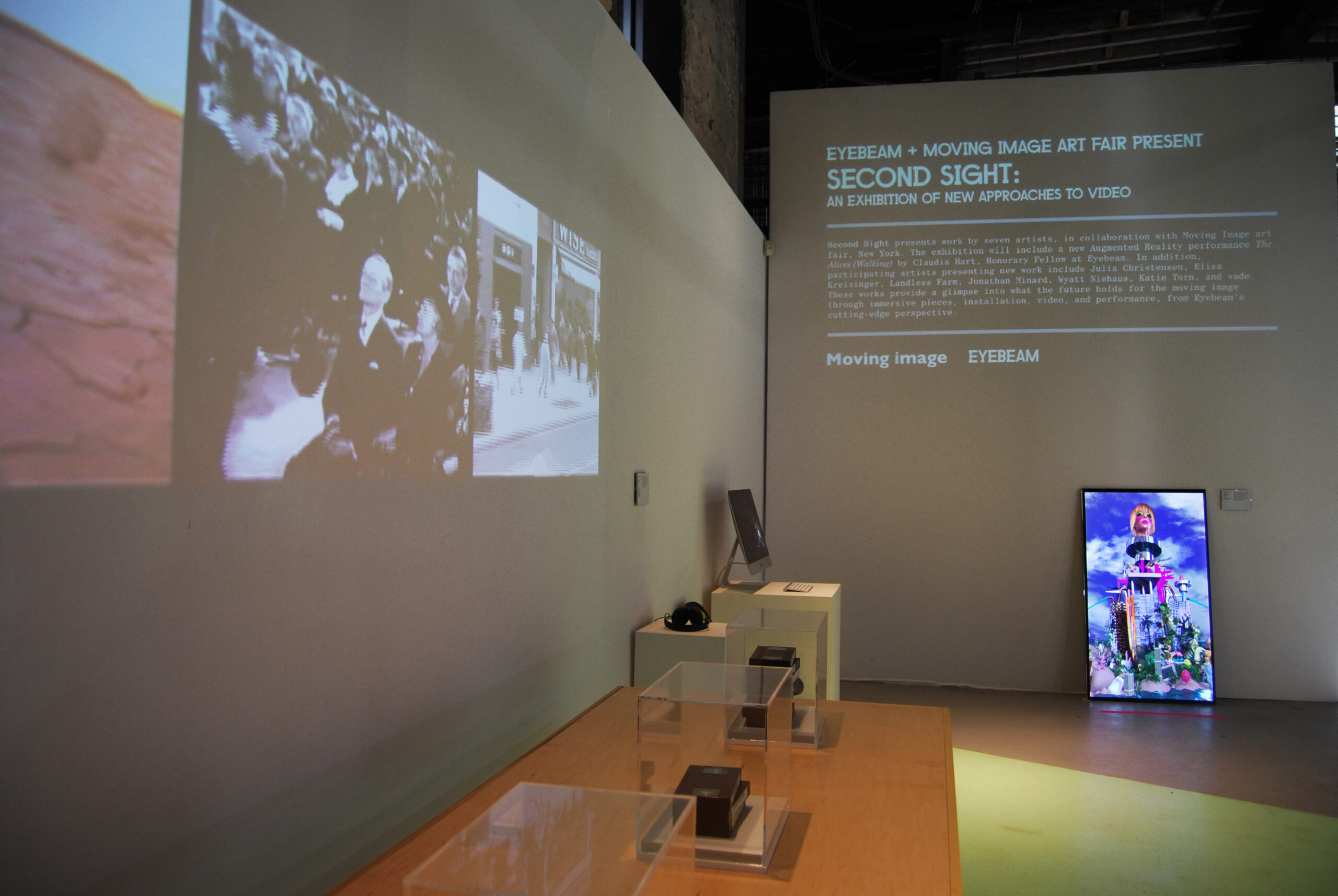
The Chuck Close Tapes is a video installation comprised of videos from a wily VHS collection that allegedly once belonged to Chuck Close. Three video streams include clips from major themes across the tapes, including New York City, Audience, and Event. The installation also includes the tapes themselves, in vitrines.
EXHIBITION: “Wave & Particle,” Ronald Feldman Gallery, NY, NY, Feb-March 2015
THE FUTURE IS IN THE LOBBY
MORE INFO
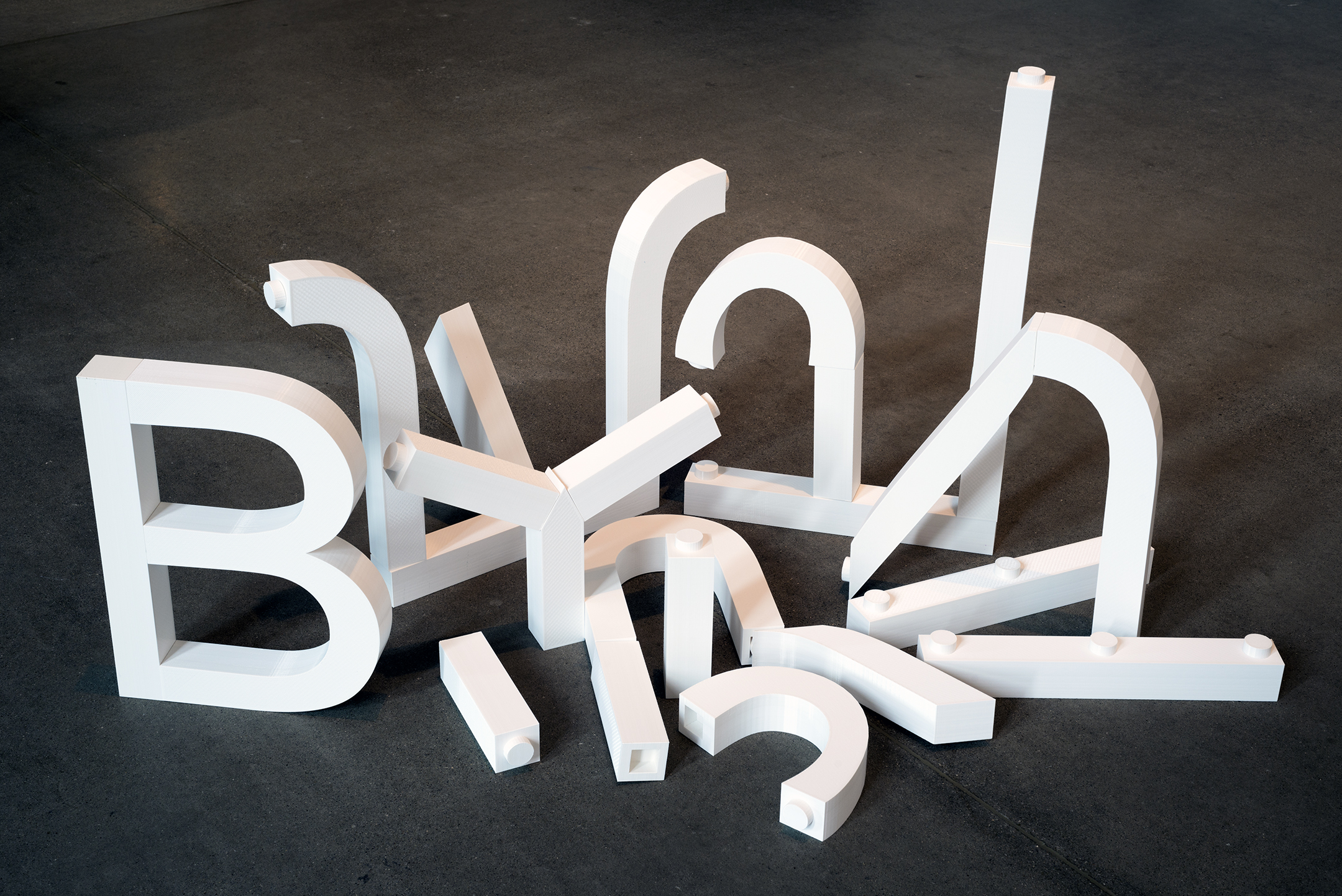
The Future is in the Lobby was commissioned by the Museum of Contemporary Art Cleveland for its opening exhibition at its current Euclid Ave site, “Realization is Better than Anticipation.” The piece is made of dozens of large 3D-printed “lego”-style blocks that spell out the words “THE FUTURE IS IN THE LOBBY.” The blocks are stored in glass vitrines in the lobby of the museum, and taken out and used by the public for live events throughout the exhibtion.
EXHIBITION CATALOG: Realization is Better than Anticipation, MOCA Cleveland, June-October 2013; “Building Blocks,” by Megan Reich
SURPLUS RISING
MORE INFO
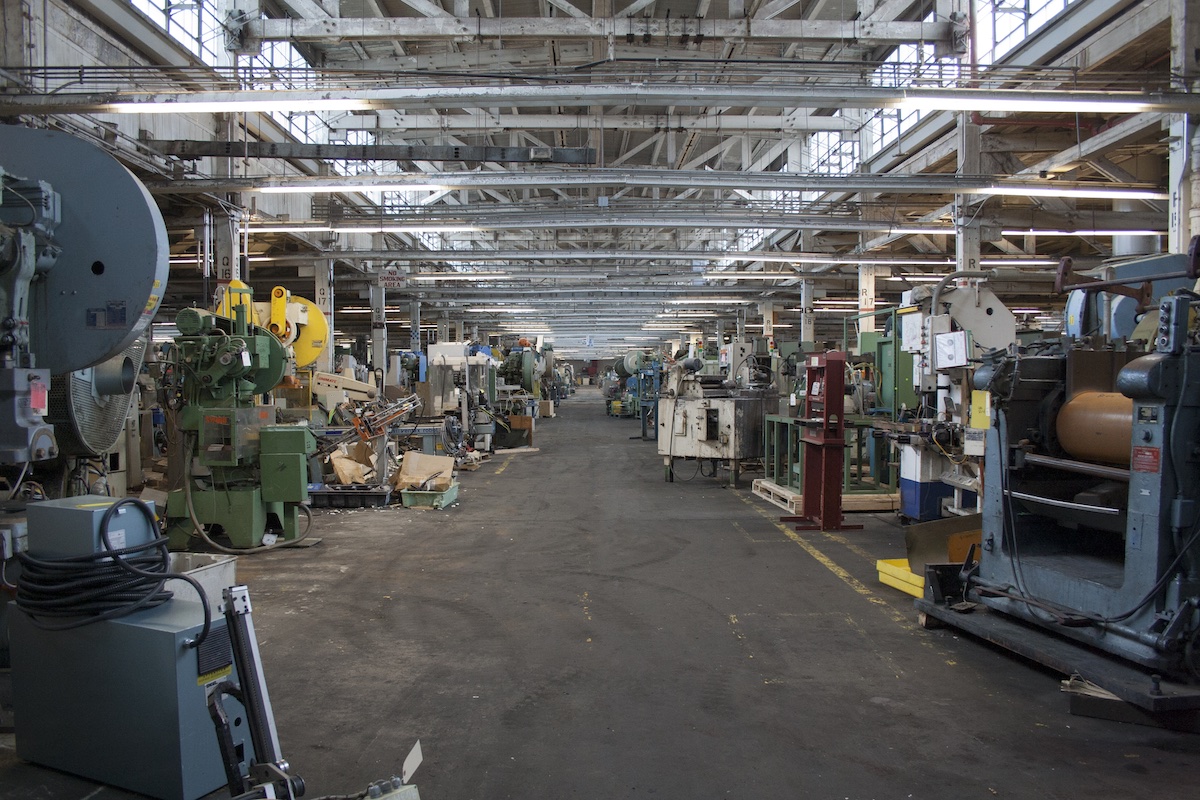
Surplus Rising is a series of photographs related to HGR Industrial Surplus, an industrial surplus depot in Cleveland, OH.
EXHIBITION: Surplus Rising at Banvard Gallery, Knowlton School of Architecture, Ohio State University, 2010
EXHIBITION: “Surplus Rising: Julia Christensen,” Powerhouse at Battery Park, produced by American Institute for Architects, 2011
THE SURVIVORS

MORE INFO
The Survivors is a slide show of photographs and drawings reimaging persistent weeds in abandoned parking lots as large, colorful creatures emerging on concrete.
EXHIBITION: “Beyond the Parking Lot,” Artisphere, Arlington, VA, 2012
THE FUTURES CYCLE
MORE INFO
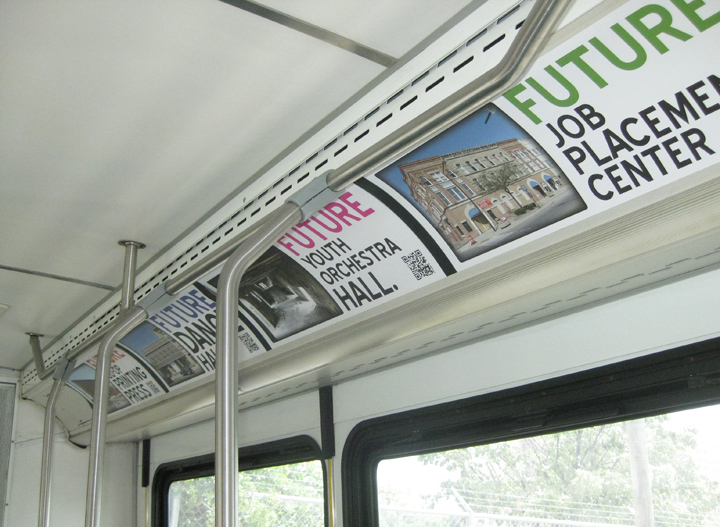
The Futures Cycle was a site-specific installation for a public bus in Arlington, Virginia. The installation consisted of panels that reimagined the future of abandoned buildings across the Rust Belt in the United States. Each panel had a QR code that led passengers to the histories and potential future uses for a dozen sites. The project also manifested as a series of photographs for gallery exhibition.
EXHIBITION: “…in a most dangerous manner…” curated by Steven Lam and Sarah Ross, SPACES, Cleveland, January-March, 2010
EXHIBITION: Art on the Art Bus: Arlington Co., Virginia
UNSUNG TORSOS: AN OPERA IN 13 PARTS
MORE INFO
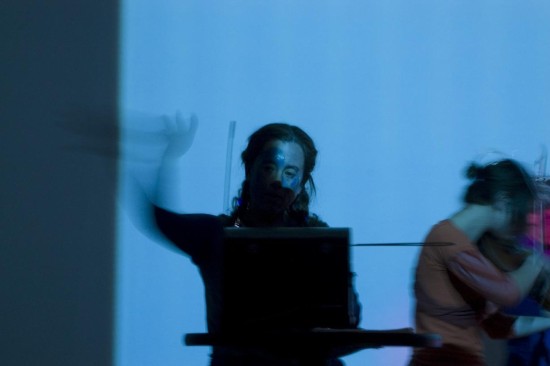
“The Unsung Torsos: An Opera in Thirteen Parts” is a multimedia performance piece written by Sarah Paul and Julia Christensen, performed at the Museum of Contemporary Art Cleveland in 2010. Christensen created a video that acted as a live score during a residency at the Experimental Television Center. Paul led/directed performers from Oberlin’s Women & Art Music ensemble, who played the piece live along with the video.
RUST BELT / BAYOU
MORE INFO
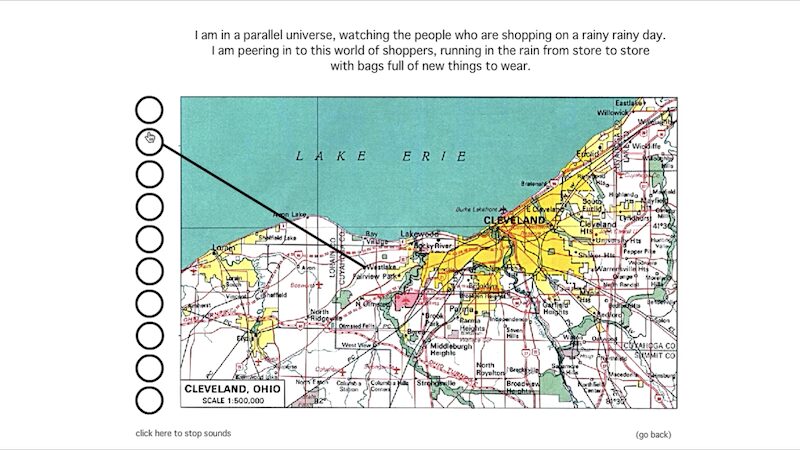
Rust Belt / Bayou is a net art project commissioned by Turbulence in 2007. The work includes sound recordings made in New Orleans, LA and Cleveland, OH. Observational writing accompanies the text, comparing and constrating the landscape of the Rust Belt and the Bayou.
LINK: Screen capture of Rust Belt / Bayou
UNBOX
MORE INFO
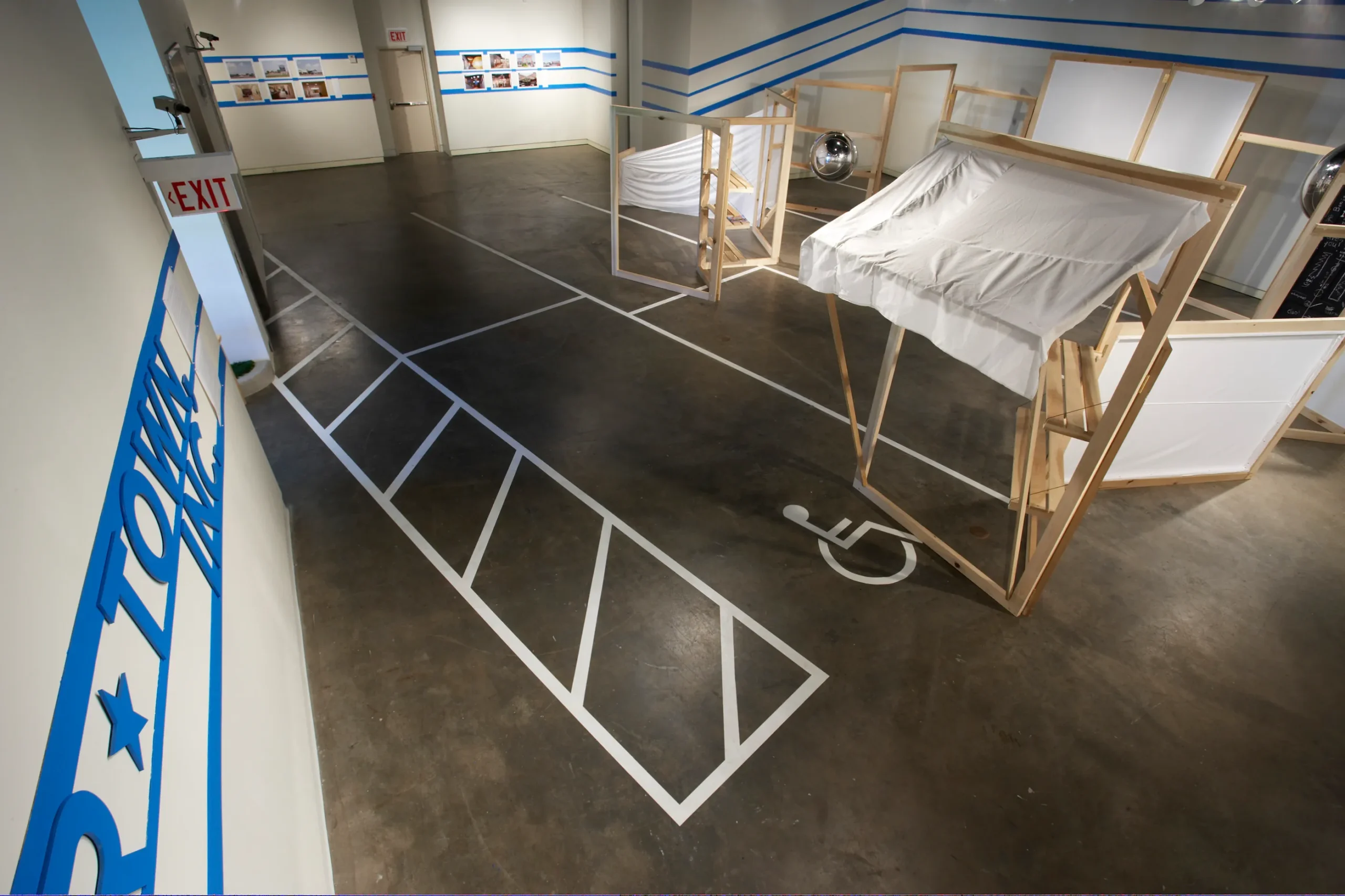
The Unbox was an installation that activated the gallery with live events throughout the course of the exhibition. The Unbox was meant to act as an antithesis to “big box” architecture, creating a simple space that was dependent upon participants to bring it to life. The structure provided space for meetings of bike coalitions, historic preservation societies, knitting groups, and book clubs.
EXHIBITION: “Your Town Inc.: Julia Christensen,” Miller Gallery, Carnegie Melon University, curated by Astria Suparak, fall 2008
EXHIBITION: “Your Town Inc.: Julia Christensen,” Richmond Center for the Arts, Western Michigan University, Kalamazoo, MI, Feb-March 2010
ARTICLE: “Exploring big boxes, in and out of the white cube,” Rhizome, September 3, 2008
ARTICLE: “Reframing the Big Box,” by Kris Ohlson, Oberlin Alumni Magazine, Spring 2009
ARTICLE: “A new art exhibition looks at life after retail for abandoned big box stores,” by Charles Rosenblum, Pittsburgh City Paper, September 4, 2008
ARTICLE: “Exhibition at Western Michigan looks at urban landscapes, reuse of abandoned buildings,” by Rebecca Bakkan, Kalamazoo Gazette, February 4, 2010
WIKIREUSE
MORE INFO
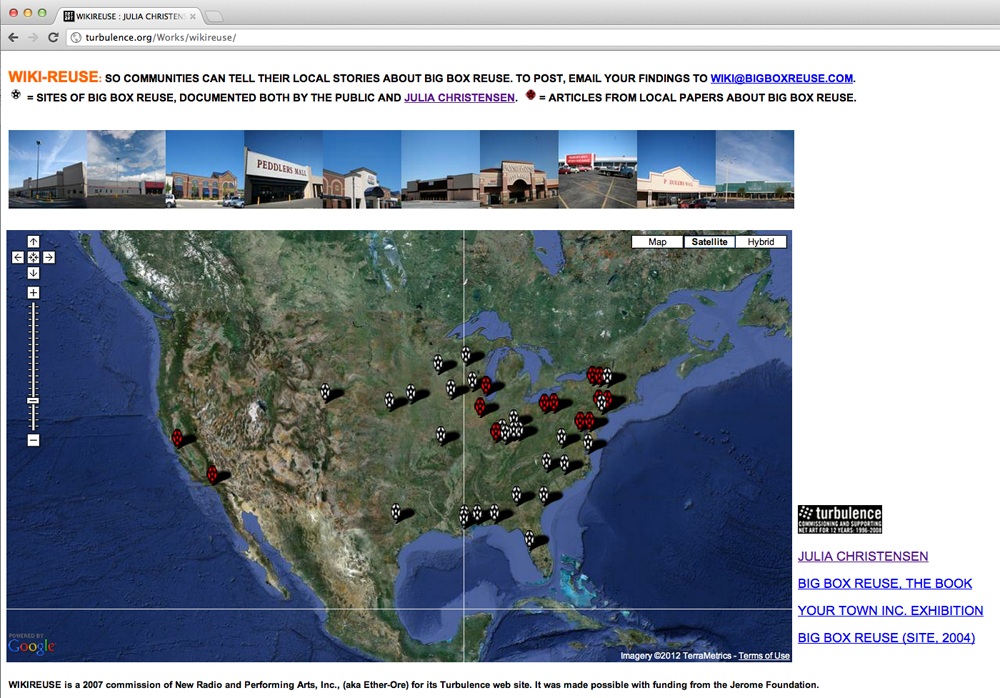
For 13 years, Julia Christensen has been creating a body of work about how communities are reusing abandoned big box buildings — the large, free-standing, warehouse-like buildings made prominent by one-stop-shopping corporations like Wal-Mart and Kmart. Treading the fine line between art and research, she created www.bigboxreuse.com in 2004. Wikireuse both updates this website and invites users to participate in its development. Nodes on a map of the United States catalog big box reuse at geo-coded locations; users can add to the map by sending in information and/or documentation about a reused big box building near them. Articles about big box reuse are also cataloged on the website, so the user can read local accounts in local newspapers from across the country.” — from Turbulence
LINK: Wikireuse on the Electronic Literature Lab
BIG BOX REUSE
MORE INFO
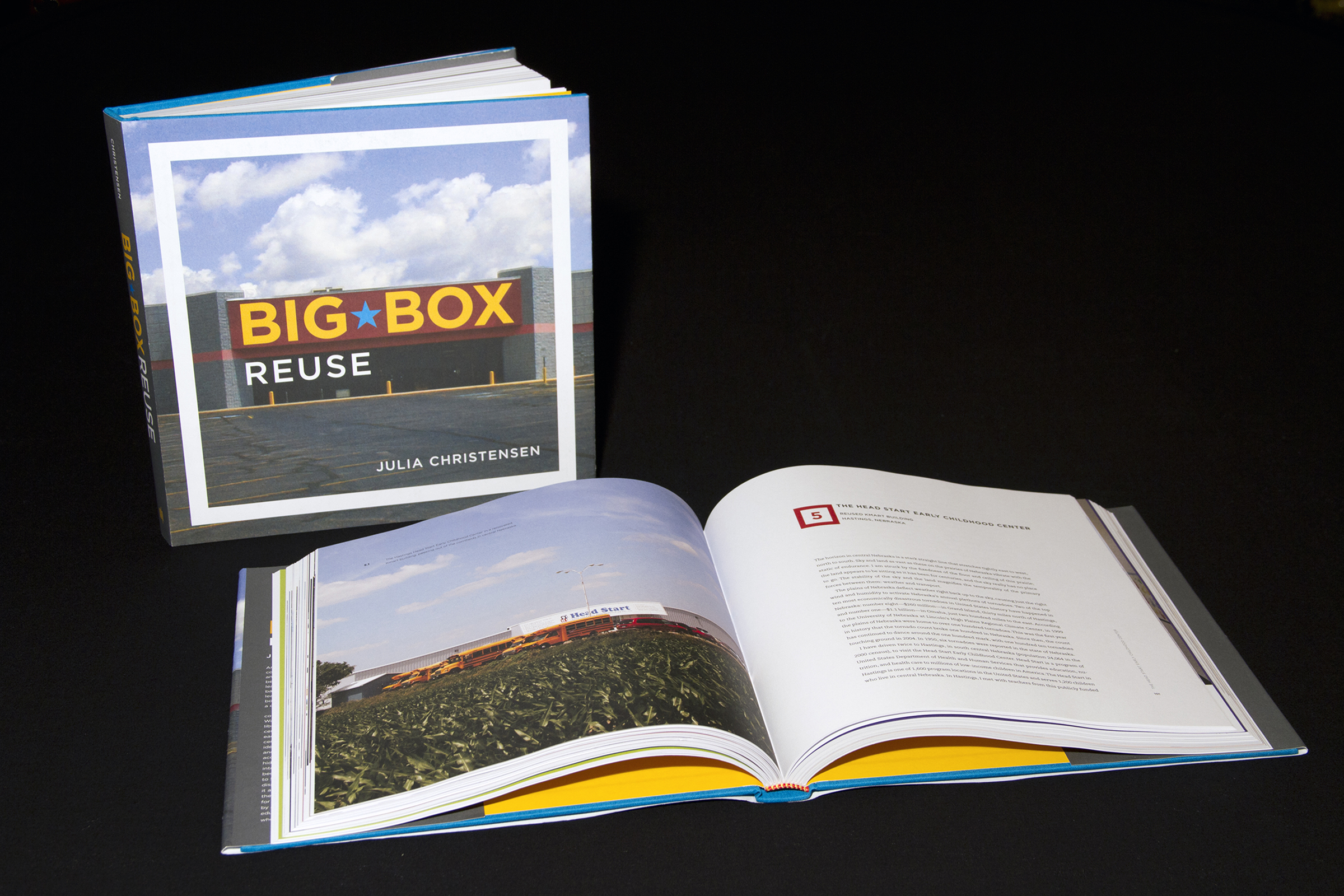
What happens to the landscape, to community, and to the population when vacated big box stores are turned into community centers, churches, schools, and libraries? America is becoming a container landscape of big boxes connected by highways. When a big box store upsizes to an even bigger box “supercenter” down the road, it leaves behind more than the vacant shell of a retail operation; it leaves behind a changed landscape that can’t be changed back. Acres of land have been paved around it. Highway traffic comes to it; local roads end at it. With thousands of empty big box stores spread across America, these vistas have become a dominant feature of the American landscape. In Big Box Reuse, Julia Christensen shows us how ten communities have addressed this problem, turning vacated Wal-Marts and Kmarts into something else: a church, a library, a school, a medical center, a courthouse, a recreation center, a museum, or other more civic-minded structures. In each case, what was once a shopping destination becomes a center of community life. Christensen crisscrossed America identifying these projects, then photographed, videotaped, and interviewed the people involved. The first-person accounts and color photographs of Big Box Reuse reveal the hidden stories behind the transformation of these facades into gateways of community life. Whether a big box store becomes a “Senior Resource Center” or a museum devoted to Spam (the kind that comes in a can), each renovation displays a community’s resourcefulness and creativity–but also raises questions about how big box buildings affect the lives of communities. What does it mean for us and for the future of America if the spaces of commerce built by a few monolithic corporations become the sites where education, medicine, religion, and culture are dispensed wholesale to the populace?
BOOK: “Big Box Reuse” by Julia Christensen on the MIT Press Book Gateway
BOOK: “Worlds Away: New Suburban Landscapes,” exhibition catalog, Walker Art Center, 2008
EXHIBITION: “Worlds Away: New Suburban Landscapes,” Walker Art Center, Minneapolis, MN, February-August 2008
ARTICLE: “Thinking inside the big box,” by Eve Kahn, New York Times, May 17, 2005
ARTICLE: “Repurpose-driven life,” by Rob Walker, New York Times Magazine, June 8, 2009
ARTICLE: “From Malls to Homes to Cars, the Transitioning of Suburbia,” by Benjamin Genocchio, New York Times, April 16, 2009
ARTICLE: “What Will Save the Suburbs?” by Allison Arieff, New York Times, January 11, 2009
ARTICLE: “Once a Walmart: the new lives of big boxes,” by Elizabeth Blair, All Things Considered, NPR, October 16, 2008
ARTICLE: “Delightful Big Box Reuse Looks at how abandoned stores are being reinvented,” by Steve Litt, Cleveland Plain Dealer, November 7, 2008
ARTICLE: “Do Schools Have to be Boring?” by Alison Lurie, New York Review of Books, December 18, 2008
ARTICLE: “Book Excerpt: Big Box Reuse,” Architect Magazine, October 20, 2008